The Short Answer: Antminer S21 vs Whatsminer M60S
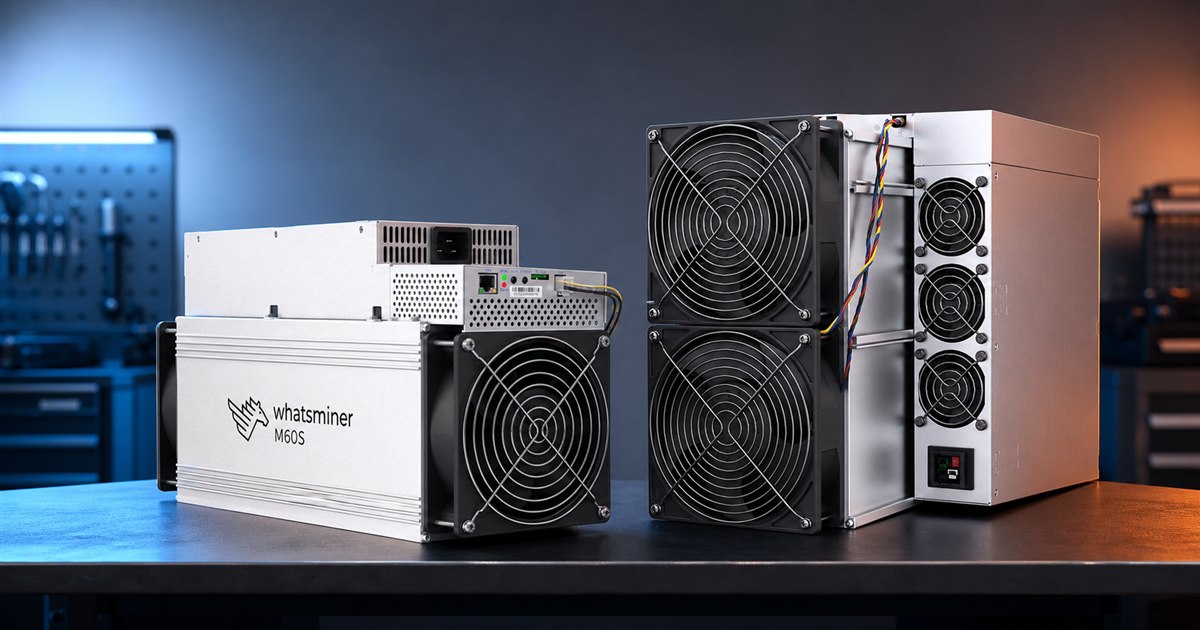
If you're trying to decide whether to buy Antminer S21 or Whatsminer M60S hardware for your next Bitcoin mining deployment, here's the short version: the S21 hashes harder for roughly the same power draw, while the M60S undercuts it on sticker price and edges it out slightly on raw efficiency. Neither one is a bad buy in 2026 — both are SHA-256 workhorses that operations of every size are still racking by the thousand. The right pick comes down to your electricity rate, your budget per unit, and how much weight you put on one vendor's firmware ecosystem over the other.
This comparison is built from the manufacturer specs and our own catalog pricing at MinerHaolan, not marketing sheets. Here's how the two machines actually stack up, unit for unit.
Antminer S21 vs Whatsminer M60S: Full Spec Comparison
| Spec | Antminer S21 | Whatsminer M60S |
|---|---|---|
| Manufacturer | Bitmain | MicroBT |
| Algorithm | SHA-256 | SHA-256 |
| Hashrate | 200 TH/s | 186 TH/s |
| Power draw | 3500W | 3422W |
| Efficiency | 17.5 J/TH | 18.4 J/TH |
| MinerHaolan price | $3,150 | $2,250 |
| Approx. cost per TH | $15.75 | $12.10 |
The gap looks small on paper, but it compounds fast at fleet scale. Fifty S21 units get you 10,000 TH/s for $157,500 in hardware. Fifty M60S units get you 9,300 TH/s for $112,500 — $45,000 cheaper, but 700 TH/s short of the S21 fleet. Which side of that trade you want to be on depends on whether you're capital-constrained or hosting-capacity-constrained.
Antminer S21: Specs and Where It Wins
The Antminer S21 ships at 200 TH/s on a 3500W power draw, for an efficiency rating of 17.5 J/TH. That's the highest raw hashrate of the two machines in this comparison, and it means fewer physical units to hit a given hashrate target — fewer PDU ports, fewer network drops, less rack space, less labor per TH deployed. For hosting facilities billing by the rack or the port, that density matters as much as the electricity bill.
If efficiency is the priority over density, Bitmain's step-up model is worth a look too: the Antminer S21 Pro pushes to 234 TH/s at 3510W for 15 J/TH, a meaningfully tighter efficiency number, at a MinerHaolan price of $4,950. It costs more per unit and more per TH ($21.15/TH) than the base S21, so it only pencils out where your power cost is high enough that the efficiency gain pays for itself over the machine's working life.
Bitmain also carries the widest install base of any ASIC manufacturer, which in practice means firmware forks, repair guides, and spare hashboards are easier to source secondhand than for most competitors — a real factor once a unit is a year or two old and outside its original warranty window.
Whatsminer M60S: Specs and Where It Wins
MicroBT's Whatsminer M60S delivers 186 TH/s at 3422W for 18.4 J/TH, priced at $2,250 on our shelf. The headline number is the entry cost: roughly $900 less per unit than the S21, for 14 TH/s less hashrate. That's a lower capital outlay per machine, which matters if you're stretching a fixed budget across more rack slots, financing a first deployment, or simply don't want to concentrate risk in a single vendor's supply chain.
There's a close sibling worth flagging too: the Whatsminer M60S+ matches the M60S almost exactly at 186 TH/s and 3441W, but its efficiency runs slightly worse at 18.5 J/TH, and it's priced at $2,199 with no current discount applied. At that gap, the base M60S is the better buy — same hashrate, better J/TH, and a lower list-to-sale spread. MicroBT's broader M6-series lineup also includes budget options like the Whatsminer M61 (172 TH/s, 3380W, 19.7 J/TH) at $1,350, which drops cost-per-TH to roughly $7.85 — worth a look if upfront capital is the tightest constraint in your plan.
Efficiency and Power Costs: J/TH Head-to-Head
On efficiency alone, the S21's 17.5 J/TH beats the M60S's 18.4 J/TH by about 5%. Run the daily power draw and the gap is smaller than most buyers expect: the S21 pulls 3500W (84 kWh/day), the M60S pulls 3422W (about 82.1 kWh/day). At an illustrative rate of $0.06/kWh, that's roughly $5.04/day for the S21 versus $4.93/day for the M60S — about 11 cents a day apart, before you even factor in the S21's extra 14 TH/s of output.
In other words, efficiency alone rarely decides this matchup. The bigger swing factor is what each TH of hashrate costs you upfront, and what it earns you at current network difficulty. Your actual power rate will move these numbers a lot, so run your own site's kWh cost — along with current difficulty and BTC price — through our profitability calculator before committing to either machine at scale.
Price and ROI: Cost Per TH Compared
Cost per TH is where the M60S pulls ahead clearly. At $12.10 per TH against the S21's $15.75 per TH, the M60S is roughly 23% cheaper to deploy per unit of hashrate. That upfront gap is larger than the efficiency gap in the other direction, which is why budget-first buyers tend to land on MicroBT hardware, while density- and longevity-first buyers tend to land on Bitmain.
The S21 Pro complicates the picture if efficiency is genuinely your bottleneck: at 15 J/TH it beats both base machines, but its $21.15 cost-per-TH means you're paying a real premium to get there. Run the math against your actual electricity rate — a Pro-tier efficiency gain only pays back where power is expensive and the miner runs for years, not months.
Reliability, Firmware, and Support: Bitmain vs MicroBT
Both companies build reliable industrial hardware — Bitmain and MicroBT are the two largest SHA-256 ASIC manufacturers on the market, and both the S21 and M60S lines run in large-scale hosting facilities today. The practical differences show up in the ecosystem around the hardware: Bitmain's larger global install base means more third-party firmware, more independent repair techs familiar with its hashboard layouts, and a deeper secondhand parts market. MicroBT's Whatsminer line has built a strong reputation for stock firmware stability and runs a proprietary control board design that some operators prefer specifically because it's less commonly targeted for unauthorized firmware tinkering.
Whichever brand you buy, every miner leaving our Hong Kong warehouse carries its manufacturer warranty (Bitmain's standard term runs around 180 days; MicroBT and other brands vary — we confirm the exact term on the product page before you check out). If you want longer protection, we offer paid warranty upgrades on top of that: Premium+ at $249 extends coverage to 18 months, and Ultra Premium at $399 adds 18 months of coverage with express repair turnaround. Full terms are on our repair and warranty page.
On the logistics side, both machines ship the same way: processed out of our HK warehouse within 1–3 business days, with standard delivery running 5–10 business days worldwide or express delivery in 2–4 days. Payment runs through bank transfer (SWIFT), crypto (BTC, ETH, USDT), or credit card for orders under $5,000 — which covers the S21, the M60S, and the S21 Pro, but not the pricier S21 XP.
Should You Buy the Antminer S21 or the Whatsminer M60S?
Buy the Antminer S21 if you're optimizing for hashrate density per rack slot, you're already running a Bitmain-heavy fleet and want parts and firmware commonality, or you plan to keep the hardware running long enough that Bitmain's deeper secondhand support market matters.
Buy the Whatsminer M60S if capital efficiency is your main constraint, you want more TH/s per dollar spent today, or you're deliberately diversifying away from a single-vendor fleet for supply-chain and firmware-risk reasons.
Neither choice is wrong at current pricing — the delta between them is a trade-off, not a mismatch. If you want to see how either machine stacks up against other current-generation options like the S21 XP, S21+, or Whatsminer M61, our comparison tool lets you line up specs side by side, and the full current lineup is in our Bitcoin miners collection and the general shop page.
Frequently Asked Questions
Is the Antminer S21 or Whatsminer M60S better for Bitcoin mining in 2026?
Neither is universally "better" — the S21 offers more hashrate (200 TH/s vs 186 TH/s) and slightly better efficiency-adjusted output at a higher price, while the M60S costs about 23% less per TH. Choose the S21 for density and long-term parts support, and the M60S if upfront capital is your tighter constraint.
Where can I buy the Antminer S21 at the best price?
MinerHaolan lists the Antminer S21 at $3,150, shipped from our Hong Kong warehouse with manufacturer warranty included. You can view it directly on the Antminer S21 product page or browse the full lineup, including the S21 Pro, on our Bitcoin miners collection.
How much more efficient is the Whatsminer M60S than the Antminer S21?
It isn't — the Antminer S21 is actually the more efficient of the two at 17.5 J/TH versus the M60S's 18.4 J/TH, a roughly 5% edge. The M60S instead wins on upfront cost per TH, at about $12.10 versus $15.75 for the S21.
Does MinerHaolan ship the Antminer S21 and Whatsminer M60S worldwide?
Yes. Both machines ship from our Hong Kong warehouse worldwide, processed within 1–3 business days, with standard delivery in 5–10 business days or express delivery in 2–4 days.
What warranty comes with the Antminer S21 or Whatsminer M60S from MinerHaolan?
Every unit carries its manufacturer warranty as standard — Bitmain's is typically around 180 days, and MicroBT's term is confirmed on the product page. You can extend coverage with our optional Premium+ ($249, 18 months) or Ultra Premium ($399, 18 months with express repair) plans, detailed on our repair and warranty page.