Why Solar and Mining Actually Fit Together
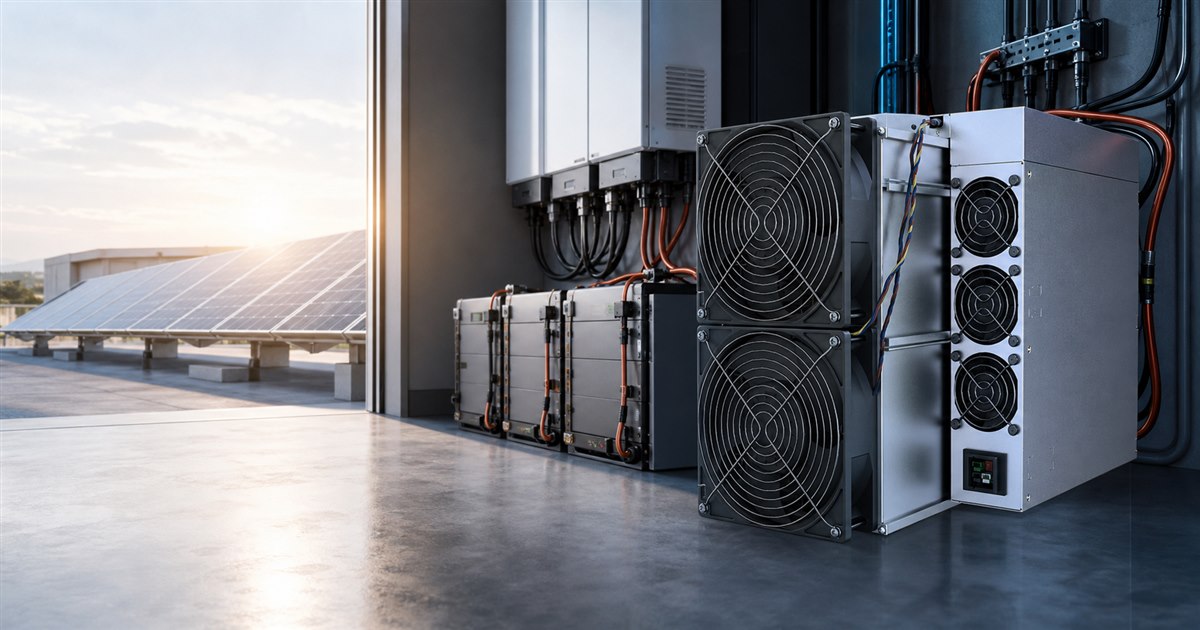
Electricity is the largest recurring cost in ASIC mining, full stop. Solar power doesn't just reduce that cost — for the hours panels are producing at capacity, it can push the marginal cost of mining close to zero. That's a fundamentally different economic position than any grid-tied setup can offer, hence the growing interest in solar-paired mining rigs even among buyers who'd never call themselves "green."
What You Actually Need
| Component | Role |
|---|---|
| Solar panels | High-efficiency monocrystalline panels recommended for space-constrained installs |
| Inverter | Converts DC panel output to AC for the miner |
| Battery storage | Enables 24/7 operation through night hours or cloud cover |
| Charge controller | Manages power flow, protects batteries from overcharge |
| ASIC miner | Choose an efficient model — solar sizing math gets easier the lower the miner's J/TH |
Sizing Your System
Take a hydro-cooled Antminer S21 Hyd (5,360W draw) as an example:
Choosing a more efficient, lower-power miner directly shrinks this number — a smaller unit or a mining schedule that follows daylight hours (rather than requiring true 24/7 grid-independent operation) both meaningfully reduce the panel and battery capacity needed.
Hybrid vs. Fully Off-Grid
Hybrid (grid + solar) is the more practical starting point for almost everyone: solar offsets electricity cost during daylight hours, grid power covers nights and low-sun days, and you avoid the battery-capacity cost of true 24/7 off-grid operation.
Fully off-grid removes the electricity bill entirely but requires meaningfully larger battery storage to cover night hours and cloudy stretches — the upfront capital cost is substantially higher, and it only really pencils out where grid connection itself is expensive, unreliable, or unavailable.
Best Practices
Frequently Asked Questions
Is solar mining actually profitable, or just environmentally nice?
Both — in regions with strong sun exposure, the electricity cost reduction is real and can meaningfully improve ROI versus paying a standard grid rate, not just a sustainability talking point.
Do I need batteries if I'm staying grid-connected?
Not strictly — a grid-tied hybrid system can run the miner on solar during the day and grid power at night without battery storage, though batteries do let you capture excess daytime generation for use later.
How much does a solar mining setup typically cost upfront?
It varies enormously by system size and location-specific installation costs, but the panel/inverter/battery cost is the majority of it — the miner itself is often the smaller line item once you're sizing a serious solar installation.
What's the biggest mistake first-time solar miners make?
Undersizing the system based on average sun hours rather than the worst realistic month — a system that works fine in summer and struggles in winter isn't actually solving the grid-dependency problem.