Why the Manufacturer Behind Your ASIC Matters
If you're comparing the best cryptocurrency miners for 2026, the brand on the box matters almost as much as the hashrate on the spec sheet. Five companies — Bitmain, MicroBT, Canaan, IceRiver, and Goldshell — build the overwhelming majority of ASIC miners in circulation, and each one has a different personality: different firmware, different resale value, different repair-part availability, and different algorithms they build best for. Picking the wrong manufacturer for your use case means overpaying for hashrate you don't need, or under-provisioning the power efficiency you'll regret once network difficulty climbs.
This guide breaks down what each major manufacturer actually does well, backs it with real specs and pricing, and tells you which one fits your mining goals — whether that's maximum Bitcoin hashrate, a quiet home rig, or a dedicated Kaspa setup.
Bitmain: The Category Leader for Bitcoin Mining
Bitmain's Antminer line is the default choice for most SHA-256 miners, and for good reason: it has the deepest firmware ecosystem, the widest resale market, and the broadest range of price tiers of any manufacturer. The current flagship, the Antminer S21 Pro, runs 234 TH/s at 3,510W for 15 J/TH efficiency and lists at $4,950. For operations chasing the lowest possible power cost, the hydro-cooled Antminer S23e Hydro pushes 540 TH/s at 10.0 J/TH — the most efficient SHA-256 unit in Bitmain's current catalog — for $7,200, though it requires a liquid-cooling loop most home miners don't have.
Bitmain also dominates the budget and mid-tier segments. The older Antminer S19j Pro still delivers 104 TH/s at 3,068W (29.5 J/TH) for $360, a reasonable entry point if your electricity is cheap and you're not chasing top-tier efficiency. Beyond Bitcoin, Bitmain fields dedicated Litecoin (Antminer L7, Antminer L9) and Kaspa (Antminer KS7) lines, so it's rarely a bad default even outside SHA-256.
Reliability-wise, Bitmain units are the easiest to get parts and repair support for, simply because they're the most common miner on the planet — hashboard swaps, PSU replacements, and firmware fixes are well documented across the industry.
MicroBT: Bitmain's Closest Rival on Efficiency
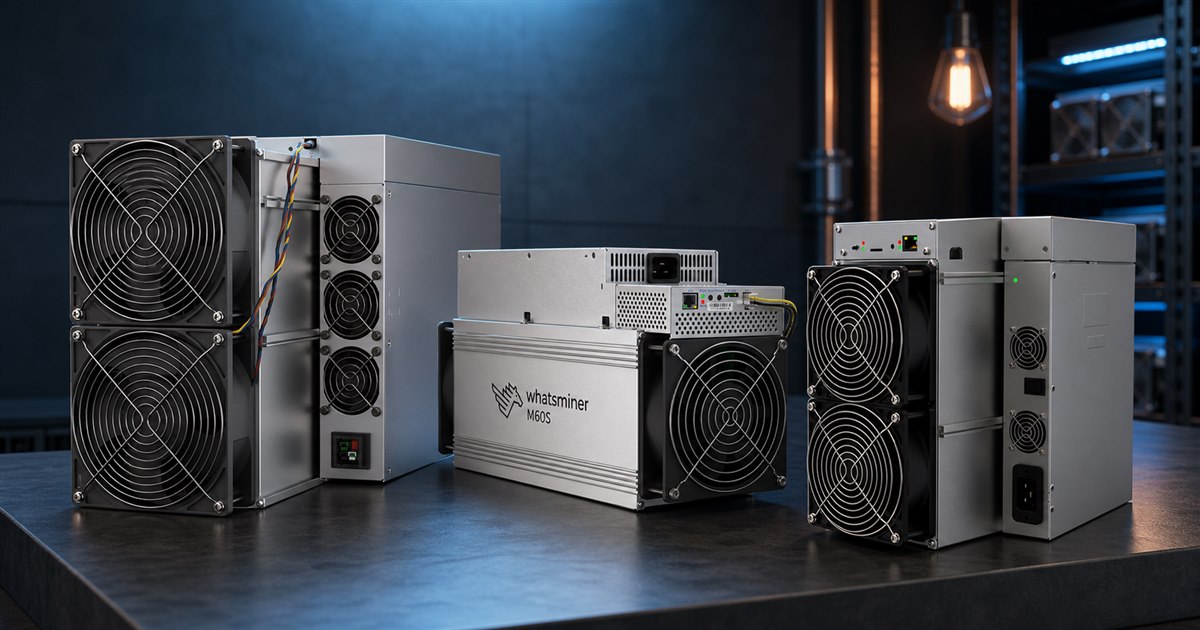
MicroBT's Whatsminer line trades some of Bitmain's brand recognition for genuinely competitive — and sometimes better — efficiency numbers. The Whatsminer M66S+ hits 298 TH/s at 5,366W (18.0 J/TH) for $4,500, undercutting comparable Bitmain hydro units on price. The Whatsminer M60S is the workhorse mid-tier option: 186 TH/s at 3,422W (18.4 J/TH) for $2,250, a genuine alternative to the Antminer S21 in the same price bracket.
MicroBT machines have a reputation among experienced operators for running slightly cooler and quieter than equivalent Antminers at the same hashrate, though the firmware ecosystem (third-party tuning tools, monitoring dashboards) is smaller than Bitmain's. Parts availability has improved significantly in the last few years but still lags Bitmain outside major mining hubs.
Canaan: The Value Play With a Long Track Record
Canaan's Avalon series is the oldest continuously-produced ASIC line in the industry — Canaan shipped some of the very first Bitcoin miners ever sold — and it's carved out a reputation as the value option without being a corner-cutting one. The Avalon A15 Pro delivers 250 TH/s at 4,350W (17.4 J/TH) for $3,150, competitive with Bitmain and MicroBT's mid-tier hydro-adjacent units at a lower entry price. Further down the range, the Avalon A1466 offers 150 TH/s at 3,300W (22 J/TH) for $1,170 — a solid mid-tier buy for operators who want current-generation firmware without flagship pricing.
Canaan is also one of the few manufacturers making a serious play in the home-mining category: the Avalon Q runs 90 TH/s at just 1,674W (18.6 J/TH) for $180, quiet and small enough to sit in a closet rather than a warehouse. Canaan's build quality is generally regarded as solid but slightly less refined than Bitmain's, and its firmware update cadence tends to run slower.
IceRiver: Built for Kaspa and Altcoins
IceRiver doesn't compete in Bitcoin at all — its entire catalog is built around KHeavyHash (Kaspa) and a handful of other algorithms, and it's the manufacturer most serious Kaspa miners default to. The IceRiver KS7 puts out 30 TH/s at 4,400W (147 J/TH) for $3,150, and the line spans everything from pocket-sized units to warehouse-scale rigs, giving Kaspa miners a genuine choice of scale that Bitmain and MicroBT's single Kaspa SKUs don't match.
Because IceRiver is a smaller company than Bitmain or MicroBT, spare parts and firmware support are more limited, and resale liquidity is thinner if you ever want to exit a coin. If you're committed to Kaspa specifically rather than treating it as a side bet, IceRiver's range depth is hard to beat — browse the full lineup in the Kaspa miners collection.
Goldshell: Small Footprint, Niche Algorithms
Goldshell built its name on compact, low-power miners for algorithms the big three largely ignore — Eaglesong, Blake2S, Handshake, and other niche coins that never got a dedicated Bitmain or MicroBT SKU. The Goldshell KA Box Pro is representative of the catalog: 2.6 TH/s at just 500W for $225, small enough for a home office and cheap enough to be a low-risk entry into Kaspa mining without committing to a 4,000W rig.
Goldshell's tradeoff is scale — these units are built for hobbyists and small operations, not warehouses, and per-terahash cost is generally higher than Bitmain's, MicroBT's, or IceRiver's full-size machines. They're the right call when a quiet, low-power footprint matters more than raw efficiency.
Best Cryptocurrency Miners by Manufacturer: Spec Comparison
| Model | Manufacturer | Algorithm | Hashrate | Power | Efficiency | Price |
|---|---|---|---|---|---|---|
| Antminer S21 Pro | Bitmain | SHA-256 | 234 TH/s | 3,510W | 15 J/TH | $4,950 |
| Antminer S23e Hydro | Bitmain | SHA-256 | 540 TH/s | 5,400W | 10.0 J/TH | $7,200 |
| Antminer S19j Pro | Bitmain | SHA-256 | 104 TH/s | 3,068W | 29.5 J/TH | $360 |
| Whatsminer M66S+ | MicroBT | SHA-256 | 298 TH/s | 5,366W | 18.0 J/TH | $4,500 |
| Whatsminer M60S | MicroBT | SHA-256 | 186 TH/s | 3,422W | 18.4 J/TH | $2,250 |
| Avalon A15 Pro | Canaan | SHA-256 | 250 TH/s | 4,350W | 17.4 J/TH | $3,150 |
| Avalon Q | Canaan | SHA-256 | 90 TH/s | 1,674W | 18.6 J/TH | $180 |
| IceRiver KS7 | IceRiver | KHeavyHash | 30 TH/s | 4,400W | 147 J/TH | $3,150 |
| Goldshell KA Box Pro | Goldshell | KHeavyHash | 2.6 TH/s | 500W | 0.19 J/GH | $225 |
All units above are in stock and ship from MinerHaolan's Hong Kong warehouse — browse the full range in the shop or run the numbers on any of them with the profitability calculator.
Which Manufacturer Should You Choose?
Maximum Bitcoin hashrate, cost-per-terahash is secondary
Go Bitmain. The S21 Pro and S23e Hydro sit at the top of the efficiency curve, and if a unit fails, replacement hashboards and repair techs are easiest to find for Antminers anywhere in the world.
Best efficiency-per-dollar in the mid-tier
Compare Bitmain's S21-class units against MicroBT's Whatsminer M60S and M66S+ side by side using the compare tool. MicroBT frequently undercuts Bitmain on price for near-identical J/TH figures.
Working with a tight budget or buying your first miner
Canaan's Avalon A1466 or an older Bitmain S19j Pro give you real hashrate without flagship pricing. Just factor in your electricity cost — older, less efficient units only make sense where power is cheap.
Mining Kaspa or another altcoin
Skip SHA-256 entirely. IceRiver's KS-series has the deepest range for Kaspa specifically, while Goldshell covers smaller niche algorithms Bitmain and MicroBT don't bother with. Check the Kaspa miners collection or, for Scrypt-based Litecoin and Dogecoin, the Litecoin miners collection featuring Bitmain's L-series.
Home mining, minimal noise and heat
Canaan's Avalon Q or a Goldshell home unit are built for exactly this — sub-2,000W draw, small footprint, livable noise levels. Don't buy a warehouse-class 5,000W+ hydro unit expecting to run it in a spare bedroom.
Buying From MinerHaolan: What to Expect
MinerHaolan (operated by HK Rumax Technology Limited) ships every miner from a Hong Kong warehouse, worldwide, within 1-3 business days of order confirmation. Standard delivery runs 5-10 business days; express shipping gets a unit to you in 2-4 days. Payment options include bank transfer (SWIFT), crypto (BTC, ETH, USDT), and credit card for orders under $5,000.
Every miner ships with its manufacturer warranty intact — Bitmain units carry roughly 180 days, and coverage length varies by brand for MicroBT, Canaan, IceRiver, and Goldshell units. If you want longer protection, two paid upgrade tiers are available: Premium+ ($249, 18 months) and Ultra Premium ($399, 18 months with express repair turnaround). Full terms are on the repair and warranty page. Questions before you order can go to support@minerhaolan.shop or WhatsApp +852 6465 3102.
Frequently Asked Questions
Which ASIC miner manufacturer is the most reliable?
Bitmain has the largest install base and the deepest repair ecosystem, which makes it the safest default if you value parts availability and resale liquidity. MicroBT and Canaan are both well-regarded for build quality and run a close second, with slightly smaller repair networks outside major mining regions.
What's actually different between Bitmain and MicroBT miners?
Both build competitive SHA-256 hardware with similar efficiency at a given price point, but Bitmain has a larger firmware and accessory ecosystem while MicroBT's Whatsminers have a reputation for running slightly cooler at comparable hashrate. Pricing between the two is usually close enough that it comes down to what's in stock and which support ecosystem you prefer.
Are older miners like the Antminer S19j Pro still worth buying in 2026?
Older, less efficient units like the S19j Pro (29.5 J/TH) can still be profitable if your electricity cost is low, since the hardware cost is much lower than current-generation flagships. Run your specific power rate through the profitability calculator before buying — efficiency matters more as electricity price rises.
Should I buy a Bitcoin miner or a Kaspa or Litecoin miner?
That depends entirely on which coin you want to mine — the algorithms aren't interchangeable, so a Bitcoin SHA-256 miner can't mine Kaspa's KHeavyHash or Litecoin's Scrypt algorithm. IceRiver and Goldshell specialize in Kaspa and other altcoins, while Bitmain's L-series covers Scrypt coins like Litecoin and Dogecoin.
What warranty comes with a miner from MinerHaolan?
Every unit ships with its manufacturer warranty — around 180 days for Bitmain, with coverage length varying by brand for other manufacturers. Optional paid upgrades extend that to 18 months, with the Ultra Premium tier ($399) adding express repair turnaround; full details are on the repair and warranty page.